
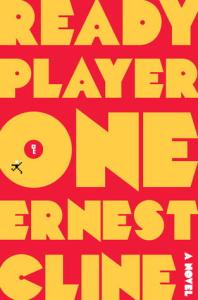
 It’s this kind of book that makes me feel like a shitty reader. I appreciate good writing. I absolutely do. I recognize a master when I see him or her. I’ve read some really good authors in the past few months, even if I didn’t necessarily agree with their plot choices. The book I’m reviewing today, Ready Player One by Ernest Cline, was not the best-written novel I’ve read by a long shot. I recognize that. But dammit if it wasn’t fun as hell.
Set in a dystopian future, Ready Player One opens in an America that has been devasated by overpopulation and an unyielding energy crisis. The only thing keeping the unwashed masses in check is a thriving virtual world called the OASIS. Here, anyone can do anything. A nobody can become somebody. A person’s wildest dreams can be realized. The possibilities in this virtual utopia are nearly limitless and many choose to live as much of their lives inside it as possible. When its creator dies suddenly and wills his fortune to whomever can find his “Easter egg” hidden in the OASIS, both the physical and virtual worlds are in an uproar. And so the race begins. Young Wade Watts, a nobody living in an Oklahoma trailer park, throws himself whole-heartedly into the search for the egg. But when he uncovers the first clue and becomes an instant celebrity, no one is as surprised as he is. Thrust into the limelight, Wade finds that the stakes in this contest are far higher than he ever imagined.
Since I began this challenge, I’ve read most of the books at a plodding pace. A couple chapters during my lunch break. A few pages before I fell asleep in the evening. But I went through this one in less than a week. The world (both real and virtual) that Cline created kept me captivated from start to finish. The descriptions of the different “planets” within the OASIS, the workings of the virtual world and the interactions of the social classes within it were very interesting to me. I also found Wade’s struggles to balance his real life with his time in the OASIS to be fascinating and somewhat heartbreaking. As a whole, the plot drew me along, keeping me in anticipation of what would happen next. It was a perfect model of rising action, climax and falling action that kept me excited and left me satisfied when it was all over. No innuendo intended.
But it wasn’t all good. The main character arc was very predictable. So were the interactions between the characters — I won’t spoil it for you by saying that, yes, of course Wade gets the girl of his dreams at the end. You can see that coming from a mile away. The protagonist, a head of an Evil Corporation, is just as much of a mindless sociopath as you would expect, with no sympathetic qualities to redeem him. There was one supporting character for whom there was a twist that I didn’t see coming (while I did guess that there would be some kind of big reveal with this character, I was wrong about what that was). But for the most part, the character development aspect of this novel was rather weak in my opinion.
The other weakness of this novel was in the mountains of information on 80s pop culture. It figures pretty majorly into the plot of the novel, but the way it’s handled ends up being kind of clunky at times. The plot can be moving along quite swimmingly, and then you get three pages talking about an 80s TV show or video game that Wade has identified as important in his quest for the Egg. It’s just kind of wedged in there, and it interrupts the flow of the story. Like, it’s neat that 80s pop culture makes a comback in the future. The juxtaposition of futuristic technology with old arcade games and references to Family Ties is kind of neat, an anachronism not so unlike the steampunk trends from a few years ago. But the way the references were handled and the way that that information was communicated to the reader seemed rather hamfisted. I think it could have been integrated into the story rather more smoothly.
But these complaints were fairly minor with regards to my enjoyment of the book. It was no great piece of literature, but it was a fun and easy read. I could definitely see myself re-reading it in a few years.
And yet, with all its fun and fantasy and sci-fi appeal, this book strikes an ominous chord. It’s easy to draw parallels between what happened to the America in which Wade Watts lives and where our own country could be headed. An energy shortage colliding with a demand fed by an ever-growing population isn’t so far-fetched. And with advances in gaming technology, particularly virtual reality devices such as Oculus Rift, it’s easy to imagine people withdrawing more and more from the real world in favor of the virtual. The jump from having conference calls or hanging out with friends over Skype to experiencing them through avatars inside a virtual environment — that’s really not that big at all. And I’m sure it’s something we’ll see in the coming years. It’s exciting, but what might the consequences be if we begin neglecting the old world to live more in the new?
But there is hope! There is aspect of Wade’s reality that will never come to fruition in our own. I have reasonable confidence that, should the citizens of our nation (and even the world) begin flocking in large numbers to one of our cities, and should that city become the world’s new metropolitan hub of technology and innovation, that city will not in fact be Columbus, Ohio.
 Adequate Squatch Presents