I really dislike Buzzfeed, so I want to make it clear that this post (or series of posts, we’ll see how far I get) is in no way condoning Buzzfeed or their clickbait articles. But a friend referred me to an article of theirs (not an article, actually, a list is more accurate) boasting “65 Books You Need to Read in Your 20s.” (Not including a link, because suck it BF.)
Well, I’M in my 20s, I thought. Let’s see how well I’ve done on this OH SO ESSENTIAL list of literature. Turns out, not very. I’ve read maybe three books on the list, and most of them I’ve never even heard of. I consider myself pretty well-read, so this made me a little angry. Why did I need to read these books? What was so special about them? I’ll show you, Buzzfeed, I thought. I’ll read all those goddamn books, you just watch, and they’ll probably be stupid anyway.
Yeah, I’m really not sure what I’m trying to prove with this one, but I’ve been cruising through books lately and continually looking for suggestions on what to read. With a year and a half left in my 20s, it seems like an interesting challenge to take on, at least to see how far I can get.
It just so happened that at the time I perused this list, I was actually re-reading one of the books (a trilogy, actually) that was on it. So if I’m going to document my journey, that seems like a good place to start.

I read Philip Pullman’s His Dark Materials trilogy for the first time when I was about 14/15. It pulled me in from the first chapter and kept me captivated all the way through to the last sentence. It made me feel emotions I’d never felt before, bringing me the greatest happiness I’d ever gotten from literature while simultaneously breaking my heart into little pieces that I struggled to make sense of in the days and weeks after I finished it. It’s been a favorite of mine since, and I’ve had to rebuy all three books multiple times when they’ve been lost to roommates, friends or relatives with whom I wanted to share the complex joy the story brought into my life.
The narrative of the first novel, The Golden Compass (originally titled Northern Lights when it was published in the UK), follows Lyra, an orphan from a universe much like our own yet notably different in several ways. When her best friend is abducted by a group rumored to be doing terrible experiments on children, she goes to great lengths to rescue him. She befriends gypsy sailors, witches and armored polar bears in a quest that takes her into the secretive, bitter cold of the icy North. On her journey she ends up involved in plans and politics far beyond her comprehension, yet in which she is destined to play an important role. She leaves her own universe in search of answers and (Book #2, The Subtle Knife) ends up meeting Will, a boy who hails from our own world and finds himself in trouble as he searches for clues to the whereabouts of his missing father. The children agree to help each other and find that their objectives have more in common than they ever would have guessed. When Will inadvertently becomes the bearer of a knife that can cut portals into other universes, they gradually come to realize that their actions may have great consequences across many worlds. Book #3 (The Amber Spyglass)…well, a lot happens and I really have no idea how to summarize it without giving spoilers, but it involves journeying to the world of the dead, a mysterious substance colloquially referred to as Dust which has some unknown connection to human consciousness, and a war against (or to liberate) Heaven itself.
I thought, perhaps, that reading it as an older adult (I did read it another time at about 20/21) might not have the same effect it had when I was young. Perhaps my raging hormones and anger at the world caused these novels to affect me much more then than they would now. I was wrong. It was just as heartbreaking this time around, leaving me, as I turned the last page, feeling like I was saying goodbye to my greatest friends.
This is not to say that the books are without flaws. Particularly in the third book, some characters just seem too pure to believable, and their adversaries seem too willing to be bowed by that purity. Plans seem to go too perfectly and dialogue seems, at certain points, too forced or elegant to be genuine. But at no point did these flaws take me out of the story, and they didn’t bother me enough to sully my love for the trilogy as a whole. I really can’t say enough how much I love this story.
Perhaps it seems that I’m ignoring the elephant in the room. The name of said elephant is Religion. These books received quite a bit of criticism for allegedly promoting an atheist, or even anti-theist, agenda. The outrage over this went so far as to have religious groups picketing screenings of the film adaptation of The Golden Compass. It’s true that Philip Pullman is an outspoken atheist and his trilogy contains strong atheist undertones — after all, one of the supporting characters literally sets out to kill God. The church and its priests are constantly working against the protagonists, and their aims and beliefs are portrayed as misguided at best, malicious at worst. Where the main characters are almost too pure, the agents of the Magisterium (thinly-veiled portrayal of the Catholic church) are almost too one-dimensionally evil. Is it still a great story? Absolutely yes. I would say that this is not a book to have your kids read if you’re raising them to be religious, but I think it’s a worthy flip-side to the coin of beloved Christianity-heavy fiction like The Chronicles of Narnia — which I also really enjoyed as a kid. (As a side note, yes I am an atheist, and no that’s not because an impressionable, young version of me read these books — that decision didn’t happen until college and was the result of a lot of study and careful consideration.) More than anything, I think that His Dark Materials encourages the reader to live a good and enriching life, rather than slogging along in anticipation of what might come after.
These books span a lot of time, space and action. They’re about a lot of things, and different aspects of the story evoke different emotions from different people. Some people will say that it’s about vanquishing religion or about finding love in an unlikely place or overcoming your flaws to do what’s right. None of those answers are wrong. I think that for me, at its core, this trilogy is about following your instincts. It’s about friendship, trust, the purest love and the consequences of those absolutely essential things. It’s about living your life with kindness and curiosity, giving it meaning through your own actions. Those are the lessons that I carry with me from my readings of these novels. Honestly, I can’t wait to read them again.
So, if I feel like it I may continue documenting my journey through this list. So check for updates if you’re at all interested. I can make no promises as to the regularity of those updates, or if they’ll happen at all. All I can say is that something might happen, and it might be interesting!

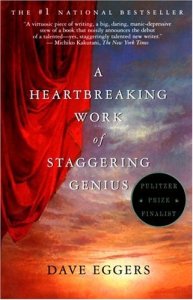 As I’m sure it was designed to do, the title of this book caught my eye. It stood out among the myriad titles on the reading list, written in pink ink on notebook paper, that I have tacked up in my cubicle. A heartbreaking work, it claimed to be, not just of regular, run-of-the-mill genius, but of staggering genius. I had no idea what it was about, just that the title made it out to be something amazing. But “heartbreaking” and “staggering genius” can describe a lot of genres. Was it a transcendent romance for the ages? Was it a tale of atrocious abuse and neglect overcome by unwavering optimism? Did it follow the lives and trials of the sentient roundworms inhabiting a planet in the Mintaka solar system? Whatever it was, I was ready to be forever changed by reading it.



 Adequate Squatch Presents