
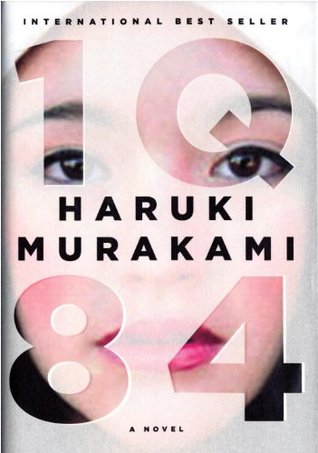
 Haruki Murakami’s epic masterpiece 1Q84 had been on my to-read list for nearly a decade. Now that the ‘rona has me staying home a lot more, I figured there was no better time for me to tackle this behemoth. Clocking in at over 1300 pages in the Kindle edition, it’s now officially the longest novel I’ve read (before now, that title was held by the extended edition of Stephen King’s The Stand). After more than two months, I finally finished it. After all that I can say, while it wasn’t without its flaws and frustrations, I enjoyed this book a lot and am glad I took the time to dive into it.
1Q84 follows Aomame, a fitness instructor-turned-assassin, and Tengo, an unassuming math prodigy and author, as they’re thrown into the bizarro world of 1Q84, which looks almost exactly like their current year of 1984, but with a few noticeable differences. As these two get tangled in the complicated webs spun by a local religious cult and its founding family, they rely on their own intuition, as well as simple fate, to find each other in the big, bustling backdrop of 1980s Tokyo.
As a novel, 1Q84 unfolds like a slow-blooming rose. Alternating back and forth between the two main characters (with a third character added to the rotation in part 3), each chapter gradually builds on the last, slowly adding backstory, dimension, and exposition. A lot of things get rehashed, which gets a little exhausting, but not enough so that I wanted to put the book down. For instance, characters, places, and routines are described over and over–like, I get it, the guy has a misshapen head, I don’t need to hear about it again. But often Murakami does this to add small details that weren’t in the preceding description, thus building rich images of these characters and places without throwing a ton of new information at the reader all at once. It’s a technique that a really appreciate, though it results in a plot that took a long while to get going and really grab my attention.
Another thing I noticed about 1Q84 is how every character is a paragon of their own virtues and talents, unmatched in their respective fields. Their instincts are spot-on, and they are consistently able to deduce much more about these tangled plot webs than the average person might be capable of. This infallible quality of the main characters lends to the sort of storybook-legend feel of the novel.
For the most part, I adored Murakami’s writing style and descriptions. The man is truly a master of prose. However, my main beef was the over-sexualization of the female characters. For instance, how come every time Aomame thinks of her deceased female friends, she thinks about their naked breasts? (Obviously anecdotal, but I’ve got plenty of female friends, and I almost never think of their tits.) Why are women fondling each other every time they end up sharing a bed? How many times do we have to be reminded that the 17 year-old cult leader’s daughter has huge boobs? Granted, this was a minor annoyance in what was overall a really great read (and to be fair, we also got plenty of mentions of Tengo’s penis, even though he never once experimented sexually with his male friends), but I did laugh out loud a couple times at the absurdity of these portrayals.
One more minor gripe: In 1300 pages, you’d think that there would be plenty of room to wrap up all those dangling plot threads. But you would be wrong. While most of the main plot arcs get resolved–and to its credit, 1Q84 does a fantastic job giving most of the main characters satisfying endings–when it was all over, I still had so many questions. Certain plot arcs were touched on but never followed up with an explanation or resolution, and others seemed like they were just about to get somewhere when the book suddenly ended. For my time investment, I do wish that certain elements of the plot had been explained or resolved better.
After spending a long time in the world of 1Q84, I find myself a little sad that it’s over. But I also feel a wonderful sense of achievement having finished this beautiful love story. Four and a half stars is probably the most accurate rating I could give this book. Now I’m off to enjoy a nice, short 300-pager.
 Adequate Squatch Presents