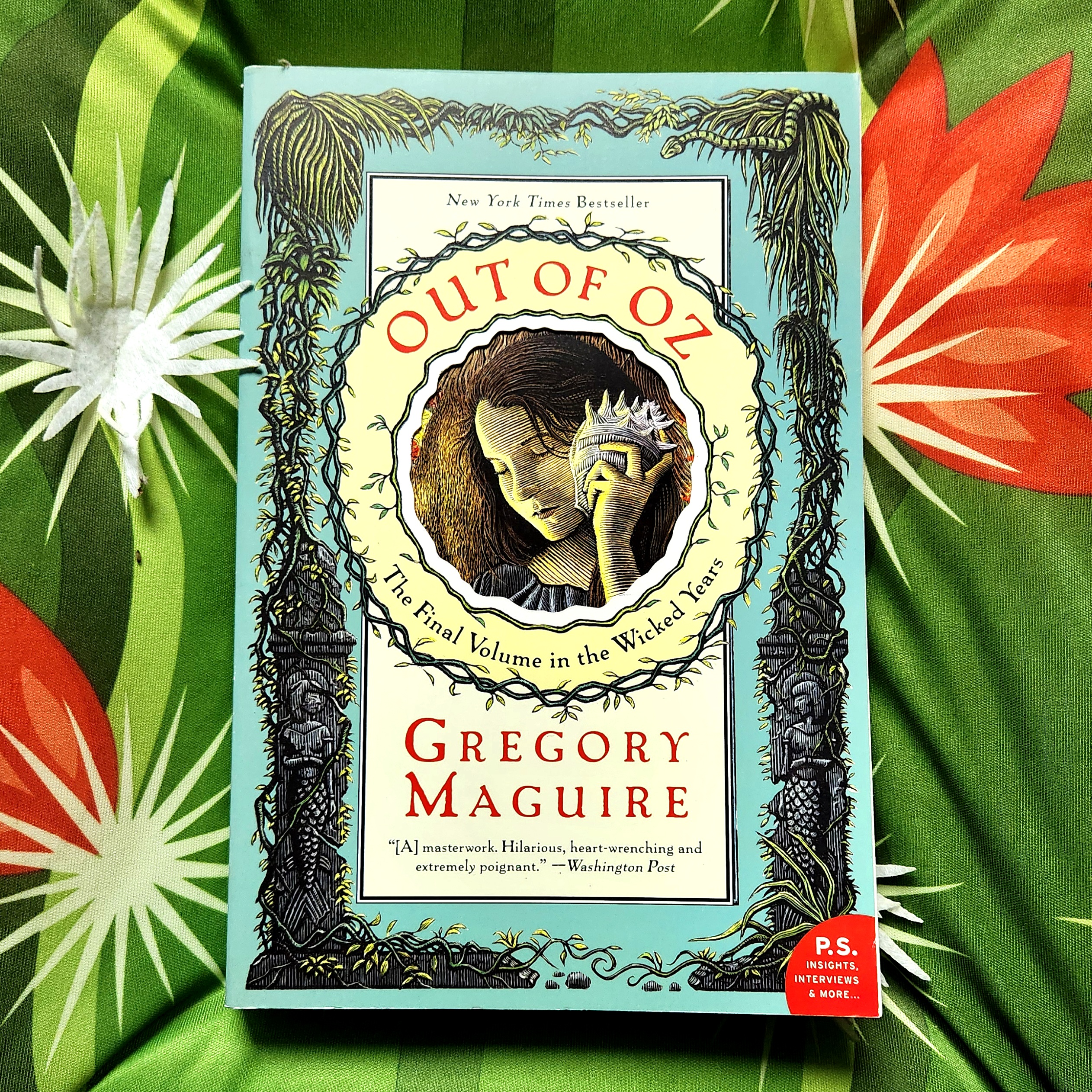
The fourth and final book in Maguire’s Wicked series, Out of Oz, had been sitting on my shelf for a decade before I finally decided to buckle down and read it. I was pretty disappointed in book three, A Lion Among Men, so I was apprehensive about this one. Wicked is among my all-time favorite books, and I didn’t want my last memory of the series to be negative. In the end, Out of Oz was pretty decent. I can’t say it’s my favorite of the series, but it brought a satisfying end to the saga of the Thropp family and seemed like a good way to wrap up Maguire’s vision of a gritty and complex land of Oz.
Summary: Social unrest bubbles through Oz as Munchkinland fights to maintain its independence and the forces of the Emerald City scheme and struggle to bring the economically crucial province back under control. Amidst the chaos, Lady Glinda finds herself under house arrest, while the Cowardly Lion is on the lam with the Clock of the Time Dragon, and rumors begin to spread of the return of Dorothy. Stuck in the center of all this hubbub is Rain, the daughter of Liir and supposed granddaughter of Elphaba, the Wicked Witch of the West. As she comes of age she’ll find that there is perhaps nothing more dangerous and challenging than being true to her roots.
***
Slipping back into Maguire’s Oz is like taking a vacation to a favorite country. It’s old, filled with secrets, and constantly healing from wounds caused by perennial conflicts. But it has a charm and richness that makes me want to keep coming back (which is probably why I’ve re-read Wicked more than almost any other book in my library). Out of Oz takes the reader through this well-developed backdrop to check in on familiar characters and meet many new and interesting ones. I loved getting to spend time with Glinda again, and even the Lion didn’t annoy me as much this time around. The main character, Rain, has a great arc and her growth as she navigates a difficult upbringing in a chaotic time is ultimately quite satisfying.
That being said, I didn’t quite LOVE this book. There were spans when it just seemed to slog on pointlessly and I couldn’t wait to be done with it. I also strenuously object to the off-screen death of a particular character whose existence seemed so important to the plot of the previous two books. Having that character die in an off-hand way for seemingly no reason felt like a slap in the face.
But this book does something right, because by the end I was riveted, emotional, and loathe to say goodbye to Oz and its colorful characters. My final impression was that this book did a great job wrapping up the Wicked Years quadrilogy.
❓ The film adaptation of Wicked (the musical) is out this month. Are you planning to go see it?
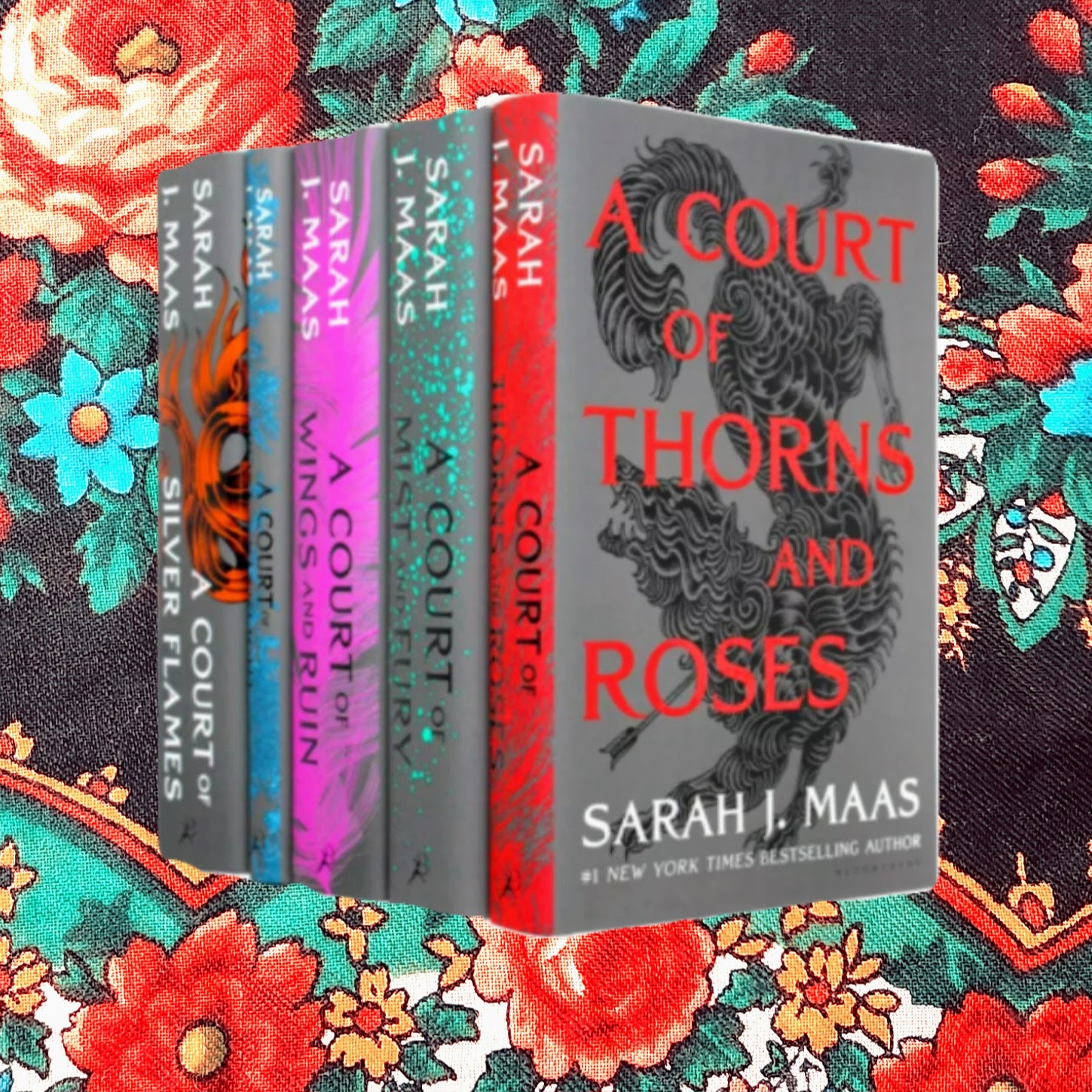
I didn’t have a smooth introduction to A Court of Thorns and Roses by Sarah J. Maas. I took the recommendation of a friend to read the first book in the series, after having recently finished and LOVED another book they’d suggested — a fantasy-adventure with a romantic subplot and a moody, opulent aesthetic. I expected A Court of Thorns and Roses to be similar to that.
Instead what I got was Beauty and the Beast: Hunger Games Edition (now with 8000% more fairies!) featuring a main character who seemed incapable of interacting with a man without wanting to simultaneously murder and bang him. I was not into it.
So I decided I wasn’t going to continue the series.
Except, I kept seeing friends talk about it. I kept getting ads for T-shirts with references to it. I kept seeing it virtually everywhere that had any books for sale, and I started to wonder why A Court of Thorns and Roses seemed to slap for everyone but me.
I waded into the second book, and it turns out everyone I talked to about this series was right: it DOES get better after the first book. The action gets a lot more interesting, as does the romance plotline, and the first novel starts to feel a lot more like a setup for the really juicy stuff. The subsequent books also reinforce the good qualities I initially overlooked about the first, like how gifted Maas is at worldbuilding, and how refreshing it is to have a romance story that celebrates female sexuality rather than fetishizing virginity.
And it’s even enjoyable to see Maas’s writing become stronger over the course of the saga.
Below are my spoiler-free short reviews of each book. Disclaimer: My main genre is horror, and while I don’t dislike romances, I don’t pick them up very often — so consider this a perspective from a genre outsider.
Book 1: A Court of Thorns and Roses Rating: ⭐⭐💫/5
Feyre Archeron is the youngest daughter of an impoverished merchant, living in a small village near the border to the Fae realm. The faeries who dwell there are lethal, devious and not to be trusted. After she kills a wolf in the woods near her home, Feyre learns that not only was the wolf a Fae male in diguise, but that she will need to pay the debt by becoming a prisoner of the wolf’s lord, a mysterious masked male named Tamlin. As her fear and hate gradually transform into curiosity and passion, Feyre will learn that many of her assumptions about the Fae were wrong. But just as she’s starting to get used to this new life, she learns of the true threat to the human and Fae realms — and that some truths about the Fae are just as terrifying as the stories she grew up on.
Though my initial impressions may have caused me to judge this book too harshly, it does suffer from some serious issues. The writing style really grated on me, and I hated how often Feyre was dumb or reckless just for the sake of the plot. And the main villain was so cartoonishly, one-dimensionally evil that it was hard to take her seriously. However, the imagery throughout is strong, and Feyre does turn out to be a well-executed main character. She doesn’t just float through the story on charm, beauty and ace skills — she makes mistakes, gets in over her head, and sometimes gets seriously injured in the process, which makes her journey more believable. While I still think it’s the weakest book in the series, it does set up plenty of interesting plot points that pay off in future books.
Book 2: A Court of Mist and Fury Rating: ⭐⭐⭐⭐/5
Safe in her new life, Feyre knows she should be ready to live her happily ever after…but she can’t seem to get past the horrors she endured under The Mountain — nor can she seem to make Tamlin understand the depth of her depression. Forced to uphold her bargain to spend time in the Night Court with Rhysand, Feyre finds herself torn between two worlds: The strong, bright Spring and the brooding, relentless Night. Now, as she faces a looming evil that threatens the balance of the Human and Fae realms alike, she’ll need to face her demons head-on in order to unlock her inner power — which could be the only key to stopping what’s coming.
A Court of Mist and Fury really cranks up the heat on this series. The stakes are higher, the twists are more breathtaking, and the sex scenes are steamier. I listened to this on audiobook, and definitely caught myself stopped dead in the middle of things I was doing, just listening with my mouth open because HOLY SHIT is there a lot of amazing action in this book. Maas’s writing style is noticeably improved in this sequel, but there are still quite a few cringe-worthy phrasings, characterizations and plot holes that I felt prevented me from completely enjoying it. Still, though, that ending had me immediately ready to jump feet-first into the next book.
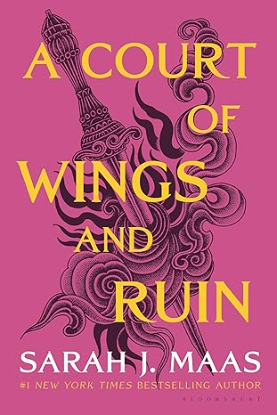
Book 3: A Court of Wings and Ruin Rating: ⭐⭐⭐/5
Feyre is back in the Spring Court, and with the King of Hybern threatening to invade Prythian with all his forces, one big question lingers in Feyre’s mind: is Tamlin her friend or her enemy? Games of deception and intrigue are afoot as she fights to get back to her sisters. But before she can return home, she needs to collect all the intel she can to make sure her new-found family doesn’t get swept away by the impending war.
A Court of Wings and Ruin is…fine, she said with a sigh. The story is engaging, it’s sexy in all the right places, and plotlines that have been brewing for a while do get some payoff. But I felt like Maas put all this momentum into getting all the moving pieces placed for this ultimate confrontation, then just kind of…prematurely ejaculated? Not my favorite metaphor, but that’s honestly what it felt like. She had all of these juicy plot elements ready to put into play, the payoff was gonna be so good…and then she blew the whole load in an unsatisfying manner over the course of just a few chapters. Moments that should have been tense and thrilling resolved fairly quickly in disappointing or predictable ways. And I had a big “Didn’t we just do this??” moment that really spoiled any positive feelings I may have developed in the first 3/4 of the book. But since I didn’t hate it all the way through, and since there were some enjoyable scenes and nice character developments, three stars it is.
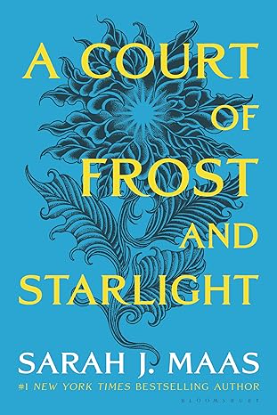
Book 4: A Court of Frost and Starlight Rating: ⭐⭐⭐💫/5
In this holiday-themed novella, Feyre faces Winter Solstice — and her birthday — in a city traumatized by the recent war. As she juggles the challenges of leadership with the struggle of finding the right gifts for her loved ones, she’ll learn that there is a glimmer of hope in every darkness.
I really love that SJM gave her characters a little holiday special. This book certainly isn’t the most exciting, but it is the shortest, so it’s already the best one in the series. Joking aside, ACOFAS is a nice little break that gives closure on some plot points from book 3, offers some enjoyable character moments, and introduces some info to get readers excited about what’s to come. Feyre continues her tradition of making idiotic decisions, but this is the character we’ve chosen to follow through an epic saga, so. However, we won’t have to deal with too much more of her, because…
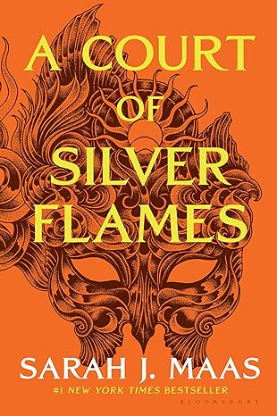
Book 5: A Court of Silver Flames Rating: ⭐⭐⭐⭐/5
After surviving the miseries of the war with Hybern, Nesta struggles to cope with her new life in Velaris. When her excesses go too far, she’s forced to move into the House of Wind where the only exit is a 10,000-step staircase. Even worse, she’ll have to undergo daily training with Cassian, the commander of Rhysand’s armies, who she’s been avoiding since the end of the war. At this point, she’s ready to give up on herself. But with a new threat looming, Nesta’s mysterious new powers may be the key to defending Prythian — once and for all.
I love it any time an author is able to get me to root for an unlikeable character, and Maas definitely got me there for Nesta in ACOSF. Before I got to this point in the series, I didn’t think I wanted to read a whole book about Nesta. However, by the end of this book, I was like, “Feyre who?” The romance plotline was fun and sexy, but I also loved the female friendships that Nesta built over the course of the story and how crucial they were to her development as a character. This would almost be a five-star book for me, except for some plot holes big enough to drive a freight train through. For the most part, though, I genuinely enjoyed returning to the world of Prythian for this story.
***
It would have been easy for me to dismiss ACOTAR as over-hyped junk, but I’m really glad I pushed past my initial impressions and kept reading — because as soapy and melodramatic as it can be, as audaciously large as some of the plot holes are, and as unabashedly horny as it is, ACOTAR does so many things right.
Unlike much of the romance genre, the characters in this series model consent, female sexual autonomy, and positive masculinity— not in every situation, but enough to be notable and refreshing.
And even though it’s a romance, it still manages to highlight and celebrate friendships between women. Those relationships aren’t just background action or devices to get the love interests together — they really matter to the plot and the development of the characters. I adore that.
Honestly, if you’ve never read the series before and are thinking about picking it up, this is what I recommend: start withA Court of Mist and Fury. This is the book that most fans seem to love best, and it’s where the “real” action of the series starts. If you like it, then treat A Court of Thorns and Roses as a prequel, and go back to get the deets on what went down between Feyre and Tamlin then. But if Book 2 doesn’t trip your trigger, then I think you can safely say that ACOTAR isn’t the series for you.
Every now and then I find myself needing to take a break from reading horror. A Court of Thorns and Roses by Sarah J. Maas has turned out to be a perfect series for that. They weren’t my favorite books I’ve read in the past couple of years, but they were a lot of fun, and it’s safe to say that I’m hooked. I will definitely be back for book 6.
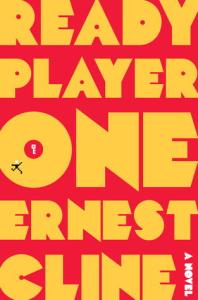
It’s this kind of book that makes me feel like a shitty reader. I appreciate good writing. I absolutely do. I recognize a master when I see him or her. I’ve read some really good authors in the past few months, even if I didn’t necessarily agree with their plot choices. The book I’m reviewing today, Ready Player One by Ernest Cline, was not the best-written novel I’ve read by a long shot. I recognize that. But dammit if it wasn’t fun as hell.
Set in a dystopian future, Ready Player One opens in an America that has been devasated by overpopulation and an unyielding energy crisis. The only thing keeping the unwashed masses in check is a thriving virtual world called the OASIS. Here, anyone can do anything. A nobody can become somebody. A person’s wildest dreams can be realized. The possibilities in this virtual utopia are nearly limitless and many choose to live as much of their lives inside it as possible. When its creator dies suddenly and wills his fortune to whomever can find his “Easter egg” hidden in the OASIS, both the physical and virtual worlds are in an uproar. And so the race begins. Young Wade Watts, a nobody living in an Oklahoma trailer park, throws himself whole-heartedly into the search for the egg. But when he uncovers the first clue and becomes an instant celebrity, no one is as surprised as he is. Thrust into the limelight, Wade finds that the stakes in this contest are far higher than he ever imagined.
Since I began this challenge, I’ve read most of the books at a plodding pace. A couple chapters during my lunch break. A few pages before I fell asleep in the evening. But I went through this one in less than a week. The world (both real and virtual) that Cline created kept me captivated from start to finish. The descriptions of the different “planets” within the OASIS, the workings of the virtual world and the interactions of the social classes within it were very interesting to me. I also found Wade’s struggles to balance his real life with his time in the OASIS to be fascinating and somewhat heartbreaking. As a whole, the plot drew me along, keeping me in anticipation of what would happen next. It was a perfect model of rising action, climax and falling action that kept me excited and left me satisfied when it was all over. No innuendo intended.
But it wasn’t all good. The main character arc was very predictable. So were the interactions between the characters — I won’t spoil it for you by saying that, yes, of course Wade gets the girl of his dreams at the end. You can see that coming from a mile away. The protagonist, a head of an Evil Corporation, is just as much of a mindless sociopath as you would expect, with no sympathetic qualities to redeem him. There was one supporting character for whom there was a twist that I didn’t see coming (while I did guess that there would be some kind of big reveal with this character, I was wrong about what that was). But for the most part, the character development aspect of this novel was rather weak in my opinion.
The other weakness of this novel was in the mountains of information on 80s pop culture. It figures pretty majorly into the plot of the novel, but the way it’s handled ends up being kind of clunky at times. The plot can be moving along quite swimmingly, and then you get three pages talking about an 80s TV show or video game that Wade has identified as important in his quest for the Egg. It’s just kind of wedged in there, and it interrupts the flow of the story. Like, it’s neat that 80s pop culture makes a comback in the future. The juxtaposition of futuristic technology with old arcade games and references to Family Ties is kind of neat, an anachronism not so unlike the steampunk trends from a few years ago. But the way the references were handled and the way that that information was communicated to the reader seemed rather hamfisted. I think it could have been integrated into the story rather more smoothly.
But these complaints were fairly minor with regards to my enjoyment of the book. It was no great piece of literature, but it was a fun and easy read. I could definitely see myself re-reading it in a few years.
And yet, with all its fun and fantasy and sci-fi appeal, this book strikes an ominous chord. It’s easy to draw parallels between what happened to the America in which Wade Watts lives and where our own country could be headed. An energy shortage colliding with a demand fed by an ever-growing population isn’t so far-fetched. And with advances in gaming technology, particularly virtual reality devices such as Oculus Rift, it’s easy to imagine people withdrawing more and more from the real world in favor of the virtual. The jump from having conference calls or hanging out with friends over Skype to experiencing them through avatars inside a virtual environment — that’s really not that big at all. And I’m sure it’s something we’ll see in the coming years. It’s exciting, but what might the consequences be if we begin neglecting the old world to live more in the new?
But there is hope! There is aspect of Wade’s reality that will never come to fruition in our own. I have reasonable confidence that, should the citizens of our nation (and even the world) begin flocking in large numbers to one of our cities, and should that city become the world’s new metropolitan hub of technology and innovation, that city will not in fact be Columbus, Ohio.
After that last book, I was feeling a bit disillusioned with my reading challenge. I hadn’t enjoyed the last few books as much as I’d hoped, and there were so many books that weren’t on the list that I actually wanted to read. So why was I wasting time with books I didn’t care about? In light of that miniature crisis, I’ve been taking a break for the last couple weeks.
I, like millions of other people, am a big fan of the A Song of Ice and Fire series. Reading it was one of the first things I did after graduating from USF, and I’ve been hooked since. Like many other GRRM nuts, I’ve spent a lot of spare time reading blogs and forums, listening to others engage in rampant speculation as they try to guess what will happen next — and it only gets worse (or better, depending on how you look at it) the more the next book gets pushed back. But reading over and over about The Grand Northern Conspiracy gets tiresome after a while. What I really needed was some actual content.
I’d been hearing for a while about the Dunk and Egg novellas. These short novels take place in Westeros a couple generations before the start of A Game of Thrones. They originally appeared in the fantasy anthologies Legends, Legends II and Warriors, and currently they are only available in those books or in graphic novel format (a collection of the three existing novellas will be released this fall). I just wanted to read the damn stories, so I tracked them down in PDF format and read them through the Kindle app on my tablet.
These three stories follow the lowborn hedge knight Ser Duncan the Tall and his squire Egg (secretly Aegon Targaryen, nephew of King Aerys I) and their adventures traveling through Westeros. Together they blunder into dangerous situations, expose treachery, and act as agents of justice. They’re short, easy reads — not nearly the level of stress and drama one gets reading ASOIAF.
I liked these novellas. They’re pretty formulaic, but have just enough little twists and turns in the plots to keep things interesting. And if you’re versed in your knowledge of Westeros, there are plenty of familiar names and locations mentioned throughout. It really adds to the rich complexity of the world that GRRM has created.
I don’t think I can really say anything here that hasn’t been said a million times all across the Internet, and I don’t want to give any spoilers, but if you’re a fan of ASOIAF, or if you enjoy watching Game of Thrones and don’t yet have the courage to take on the books, these are a great way to pass the time until The Winds of Winter and/or Season 5 comes out.
So that was a nice little detour. I’m already back to my reading challenge list — for now.
I really dislike Buzzfeed, so I want to make it clear that this post (or series of posts, we’ll see how far I get) is in no way condoning Buzzfeed or their clickbait articles. But a friend referred me to an article of theirs (not an article, actually, a list is more accurate) boasting “65 Books You Need to Read in Your 20s.” (Not including a link, because suck it BF.)
Well, I’M in my 20s, I thought. Let’s see how well I’ve done on this OH SO ESSENTIAL list of literature. Turns out, not very. I’ve read maybe three books on the list, and most of them I’ve never even heard of. I consider myself pretty well-read, so this made me a little angry. Why did I need to read these books? What was so special about them? I’ll show you, Buzzfeed, I thought. I’ll read all those goddamn books, you just watch, and they’ll probably be stupid anyway.
Yeah, I’m really not sure what I’m trying to prove with this one, but I’ve been cruising through books lately and continually looking for suggestions on what to read. With a year and a half left in my 20s, it seems like an interesting challenge to take on, at least to see how far I can get.
It just so happened that at the time I perused this list, I was actually re-reading one of the books (a trilogy, actually) that was on it. So if I’m going to document my journey, that seems like a good place to start.
I read Philip Pullman’s His Dark Materials trilogy for the first time when I was about 14/15. It pulled me in from the first chapter and kept me captivated all the way through to the last sentence. It made me feel emotions I’d never felt before, bringing me the greatest happiness I’d ever gotten from literature while simultaneously breaking my heart into little pieces that I struggled to make sense of in the days and weeks after I finished it. It’s been a favorite of mine since, and I’ve had to rebuy all three books multiple times when they’ve been lost to roommates, friends or relatives with whom I wanted to share the complex joy the story brought into my life.
The narrative of the first novel, The Golden Compass (originally titled Northern Lights when it was published in the UK), follows Lyra, an orphan from a universe much like our own yet notably different in several ways. When her best friend is abducted by a group rumored to be doing terrible experiments on children, she goes to great lengths to rescue him. She befriends gypsy sailors, witches and armored polar bears in a quest that takes her into the secretive, bitter cold of the icy North. On her journey she ends up involved in plans and politics far beyond her comprehension, yet in which she is destined to play an important role. She leaves her own universe in search of answers and (Book #2, The Subtle Knife) ends up meeting Will, a boy who hails from our own world and finds himself in trouble as he searches for clues to the whereabouts of his missing father. The children agree to help each other and find that their objectives have more in common than they ever would have guessed. When Will inadvertently becomes the bearer of a knife that can cut portals into other universes, they gradually come to realize that their actions may have great consequences across many worlds. Book #3 (The Amber Spyglass)…well, a lot happens and I really have no idea how to summarize it without giving spoilers, but it involves journeying to the world of the dead, a mysterious substance colloquially referred to as Dust which has some unknown connection to human consciousness, and a war against (or to liberate) Heaven itself.
I thought, perhaps, that reading it as an older adult (I did read it another time at about 20/21) might not have the same effect it had when I was young. Perhaps my raging hormones and anger at the world caused these novels to affect me much more then than they would now. I was wrong. It was just as heartbreaking this time around, leaving me, as I turned the last page, feeling like I was saying goodbye to my greatest friends.
This is not to say that the books are without flaws. Particularly in the third book, some characters just seem too pure to believable, and their adversaries seem too willing to be bowed by that purity. Plans seem to go too perfectly and dialogue seems, at certain points, too forced or elegant to be genuine. But at no point did these flaws take me out of the story, and they didn’t bother me enough to sully my love for the trilogy as a whole. I really can’t say enough how much I love this story.
Perhaps it seems that I’m ignoring the elephant in the room. The name of said elephant is Religion. These books received quite a bit of criticism for allegedly promoting an atheist, or even anti-theist, agenda. The outrage over this went so far as to have religious groups picketing screenings of the film adaptation of The Golden Compass. It’s true that Philip Pullman is an outspoken atheist and his trilogy contains strong atheist undertones — after all, one of the supporting characters literally sets out to kill God. The church and its priests are constantly working against the protagonists, and their aims and beliefs are portrayed as misguided at best, malicious at worst. Where the main characters are almost too pure, the agents of the Magisterium (thinly-veiled portrayal of the Catholic church) are almost too one-dimensionally evil. Is it still a great story? Absolutely yes. I would say that this is not a book to have your kids read if you’re raising them to be religious, but I think it’s a worthy flip-side to the coin of beloved Christianity-heavy fiction like The Chronicles of Narnia — which I also really enjoyed as a kid. (As a side note, yes I am an atheist, and no that’s not because an impressionable, young version of me read these books — that decision didn’t happen until college and was the result of a lot of study and careful consideration.) More than anything, I think that His Dark Materials encourages the reader to live a good and enriching life, rather than slogging along in anticipation of what might come after.
These books span a lot of time, space and action. They’re about a lot of things, and different aspects of the story evoke different emotions from different people. Some people will say that it’s about vanquishing religion or about finding love in an unlikely place or overcoming your flaws to do what’s right. None of those answers are wrong. I think that for me, at its core, this trilogy is about following your instincts. It’s about friendship, trust, the purest love and the consequences of those absolutely essential things. It’s about living your life with kindness and curiosity, giving it meaning through your own actions. Those are the lessons that I carry with me from my readings of these novels. Honestly, I can’t wait to read them again.
So, if I feel like it I may continue documenting my journey through this list. So check for updates if you’re at all interested. I can make no promises as to the regularity of those updates, or if they’ll happen at all. All I can say is that something might happen, and it might be interesting!
I didn’t mean to read this book. I picked it up at Goodwill for $0.50, having recognized it as perhaps the one book there that wasn’t a grocery store romance novel, or an outdated programming manual. It sat under my bed for a couple of months, until I found it during one of my rare cleaning excursions. So I pushed back three other novels I’d been planning to read, and started in on this. I have to say, it kept me interested. I was amazed at how fast I got through it. And now I suppose you’re waiting for me to say, “But…” Stay tuned, kittens.
Neverwhere starts out with a gentleman named Richard Mayhew, an average guy living in London with an average job, an overbearing fiance, and an overall unperturbed life. Until one day he stumbles over a young girl bleeding on the sidewalk. After helping her, he finds that not only is he all but invisible to the world he knows, but he and the girl (named Door) are also being pursued by the two most efficient and macabre mercenary murderers in London Below. As they search for the person at the root of this business, Richard will discover things about himself that the London-Above Richard never would have thought possible.
The good: Neverwhere kept me turning the pages. Gaiman has a very engaging writing style, so that even if you don’t particularly like the story, you still want to finish it.
A lot of the characters were immensely enjoyable. Croup and Vandemar, the villainous mercenaries, really made the book for me. Door was very interesting, too, in her own quiet, girlish way. Really, the backdrop of London Below was the most enjoyable character in the whole book. I really savored getting to know its quirks and surprises. It was like a dirty, mangy puppy that you know you should stay away from, but you can’t help inviting into your home.
The bad: Now, admittedly, I haven’t read a lot of Gaiman’s work. But it seems that, between this and American Gods, he tends to like using the same general template for a main character: A dull, uninteresting guy who finds himself thrown into a land of fantasy, and ends up fitting into it pretty well, actually. I didn’t like Shadow from American Gods, and I don’t like Richard Mayhew, either. Neither of them were particularly exciting or well-developed characters. It seems like Gaiman makes really great supporting characters, but totally flops with the main characters.
Other that that, Neverwhere was pretty predictable. It didn’t really throw me any curve balls. That’s not necessarily a bad thing, but it doesn’t add points either. Overall, a nice light read, if you don’t mind a main character who you want to reach into the pages and slap.
The Melancholy of Haruhi Suzumiya by Nagaru Tanigawa
I’ve never been a big fan of manga, which is probably why I’d never heard of this novel until quite recently. Apparently, it’s more or less the Japanese incarnation of Twilight. Not so much because of vampires and romance, but moreso because it’s a sub-par novel that has become an international craze. At least enough of a craze for its English translation to have a display near the front of Borders. When I mentioned it to my manga-nerd friends, they knew exactly what I was talking about. The novel has been adapted into a graphic novel, as well as an animated TV show. I figured it was about time for me to get my claws into it.
The plot of the novel caught my eye, and was the reason I picked it up in the first place. The narrator, Kyon, attends his first day of high school and meets Haruhi Suzumiya, a beautiful and sour young lady who soon becomes infamous for her strange behavior and self-proclaimed disinterest in “ordinary humans.” Together, Kyon and Haruhi start up the SOS Brigade, whose aim is to find espers, aliens, and time-travelers. More importantly, the SOS Brigade is supposed to keep Haruhi occupied so that she won’t destroy the world with the amazing power that she unknowingly wields. As Kyon gets dragged along for the ride, he discovers that his life is not as ordinary that he thinks, and probably never will be ordinary again.
My biggest beef with this novel is how much it tells and how little it shows. I don’t want Tanigawa to tell me that Haruhi is angry. I want to figure out that she’s angry by the way she slams her books on the desk. I don’t want Kyon to say that he’s hot, I want the imagery of his sweat-soaked school uniform. The lack of this type of description made the book very boring for me, and it took me over two weeks to finish its 224 pages, just because I couldn’t read more than a few without losing interest.
Beef number two was the overuse of similes. Tanigawa is apparently very fond of them, and they’re not particularly good similes. Sometimes there were several in the same paragraph (like college kids crammed into a phone booth?).
I was disappointed. The premise of the novel was very good. There were times when the novel surprised me with phenomenal insight just when I was about to throw it in the trash. Unfortunately, Tanigawa failed to expand on the more interesting aspects of the plot, and mostly stuck to describing the characters mundane day-to-day school lives in lifeless detail.
One more thing, it irked me how every main character in The Melancholy of Haruhi Suzumiya seemed to be uncommonly beautiful. I like to see flaws in my characters. It makes them more real. Mikuru Asahina could have had a crooked nose from a childhood accident. Or Haruhi could have had frizzy, untameable hair. But they didn’t. Tanigawa described them all as being close to perfection, and that annoyed me to no end.
Why are you so popular, Haruhi? Maybe I’ll just never understand what draws the masses. At any rate, this will probably be the last time for a while that I’ll try anything manga-related.
The critically acclaimed author of Wicked: The Life and Times of the Wicked Witch of the West brings us another fairy tale re-imagining in the form of Mirror Mirror, a retelling of the classic Snow White and the Seven Dwarves. Falling somewhat short of the high bar set by Wicked, Mirror Mirror makes up for in vivid imagery what it lacks in character development. Did…did that opening sound pretentious and douchebaggy? Okay, good. I think that means I’m doing this right.
Set in the hills of Italy, Mirror Mirror follows the misfortune of Don Vicente de Nevada and his young daughter Bianca. Their quiet life on their plantation Montefiore leaves them unprepared for the arrival of Cesare Borgia and his sister Lucrezia–and the impossible quest that they have in store for Don Vicente. He unwillingly leaves his daughter in the care of the unsettlingly attractive Lucrezia. Perhaps not the best choice. Out of jealousy of her brother’s attention to the pretty young Bianca, Lucrezia sends the young girl into the wilderness to die. As you might expect, she does not die, but falls under the care of some decidedly un-Disneylike dwarves. What follows is a tale as surprising in its originality as it is faithful in its homage to the classic Snow White tale.
I loved Gregory Maguire’s decision to use Lucrezia Borgia as the wicked queen. Infamous for her lethality, mystery, and beauty, the historical Lucrezia was a fairy tale in and of herself. To write her into this classic story was a great move. Mirror Mirror portrays Lucrezia as proud, headstrong, and confident. She is capable of love, but is too instilled with cold ruthlessness to show it.
The dwarves–eight of them in this version–are very interesting as well. Stone golems with a home that is as much a character in the story as they are. I have to say, though, that they fit a little oddly into the story. The way they referred to the human world almost with disdain made it seem unlikely that they would be so interested in the well-being of a young girl. Perhaps they were just more complex than I thought.
Which brings me to Snow White–or Bianca de Nevada in this story. Though she is the center of the plot, Bianca seems to be a secondary character in Maguire’s novel, behind Vicente and Lucrezia. I would have liked to see her character developed a bit more, but she came off as rather bland and one-dimensional. No personality at all. Just a plot device attached to a pretty face.
The romantic in me was disappointed in the lack of a Prince Charming in this story. It seems like Maguire noticed this at the last minute and shoved another character into that role, to a rather forced and unromantic effect.
I very much enjoy Maguire’s writing style. His language is colorful and poetic without coming off as too flowery. It’s one of the saving graces of the novel, and it’s what keeps me going back to read his work. He is able to paint a picture with words, so rich and vibrant that I almost feel like I could reach through the pages and pluck a branch from one of the olive trees in Montefiore.
While the overall effect that Mirror Mirror had on me was disappointment, I appreciated the novel for its adept imagery and the fresh twist it gave to a classic tale. Though that seems to be Maguire’s shtick.

 It’s this kind of book that makes me feel like a shitty reader. I appreciate good writing. I absolutely do. I recognize a master when I see him or her. I’ve read some really good authors in the past few months, even if I didn’t necessarily agree with their plot choices. The book I’m reviewing today, Ready Player One by Ernest Cline, was not the best-written novel I’ve read by a long shot. I recognize that. But dammit if it wasn’t fun as hell.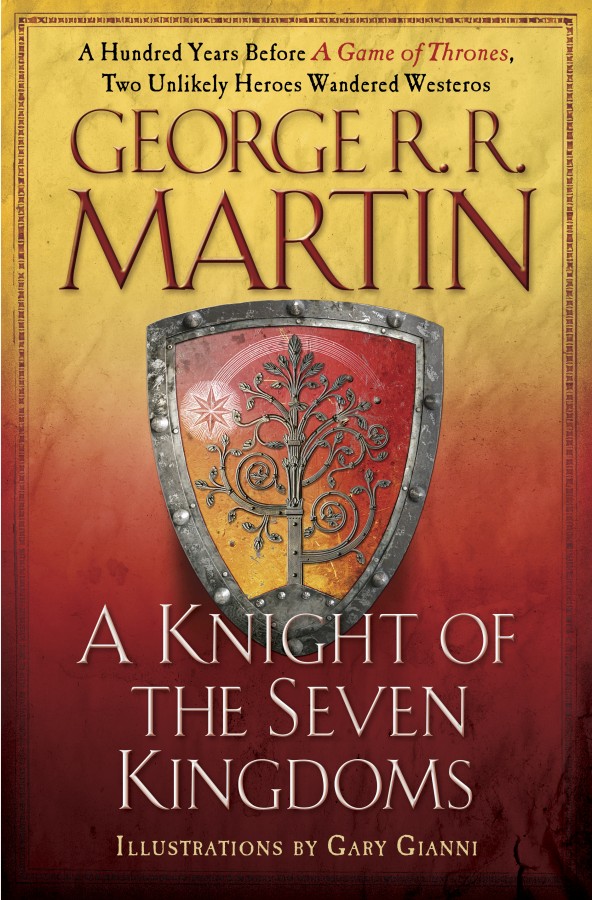


 Adequate Squatch Presents