
Rating: ⭐⭐⭐⭐⭐/5
I am always blown away by the literary wonder woman Joyce Carol Oates. Earlier this year I was lucky enough to attend a live interview and book signing featuring this absolute icon, as part of the AViD visiting authors series put on by the Des Moines Public Library. At the age of 86, Oates still manages to put out at least one book every year, in addition to numerous short stories, poems and collections. Seriously, what a powerhouse.
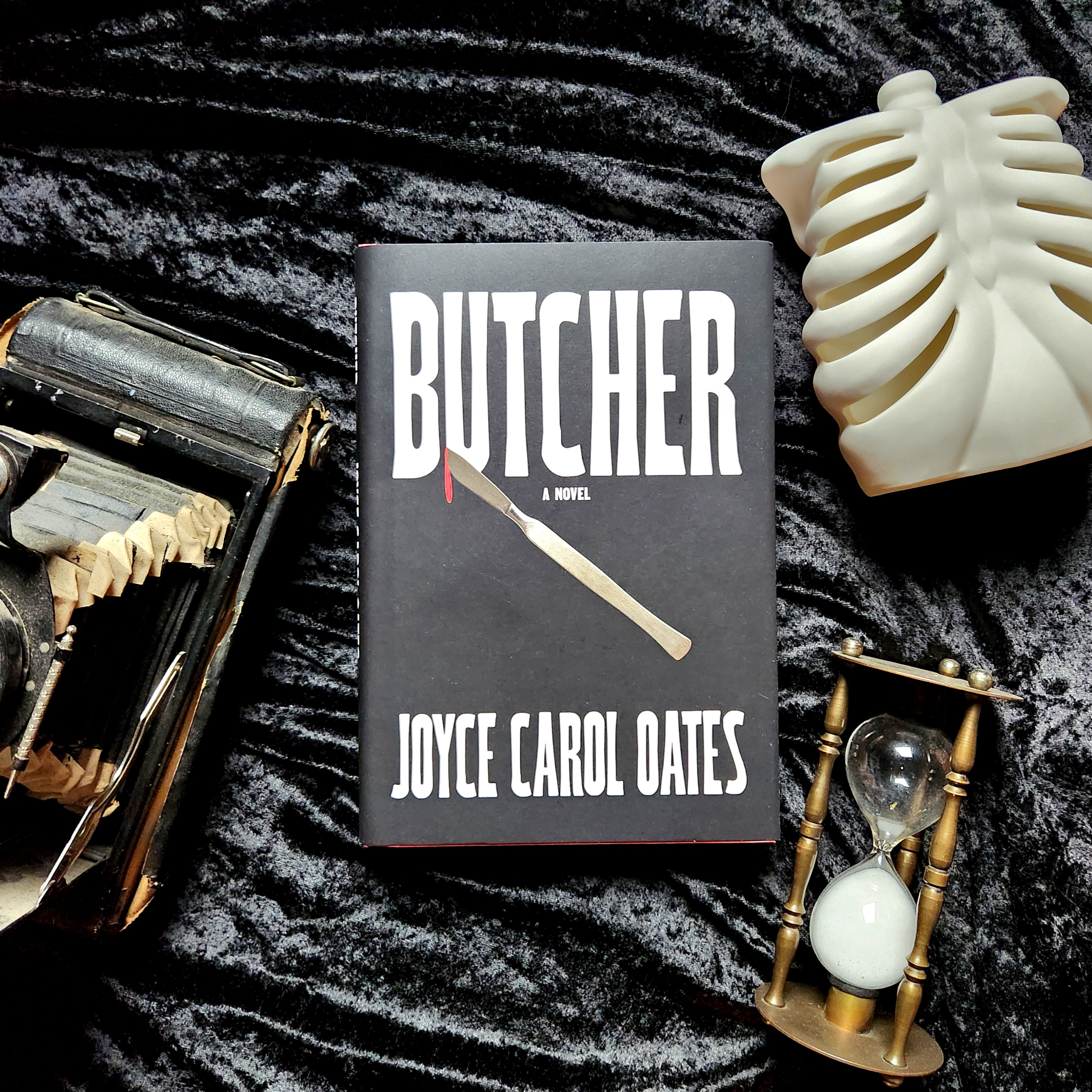
Anyway, the event in question was celebrating her newest novel Butcher, which I couldn’t go home without a (signed!) copy of. This book promised to check so many of my “yes” boxes: historical fiction, an old-timey asylum, medical horror, cathartic revenge, and the humiliation of an infuriatingly wrong yet cocksure man in a position of authority. I was fully on board. Butcher didn’t disappoint.
Summary:
Butcher is a collection of essays, journals and interviews chronicling the life of Dr. Silas Weir, the “Father of Gyno-Psychiatry.” Forced to take a position at a New Jersey asylum for “female lunatics” following a professional humiliation, Weir carves out a niche for himself by subjecting the neglected women under his care to a wide range of horrifying experiments so he can publish the results. Operating unsupervised and unchecked in his position for decades, Weir becomes obsessed with a young servant named Brigit, who will become both his primary experimental subject and his eventual undoing.
***
This book was equal parts horrifying and intriguing. Using multiple points of view, Oates paints a thoroughly convincing picture of a 19th century doctor drunk on power and hungry for notoriety. Through Weir’s own journal entries, we see a man who is unapologetically classist, repulsed by the female body, and so self-assured in his own faith and medical training that he truly believes he’s blessed with divine insight to heal the female body and mind—even as he subjects his patients to the most inhumane treatments. Weir is a great example of an unreliable narrator: he’s really convinced that he’s doing good for his patients, although the subtext shines through bright and clear to show the monster hiding underneath. His point of view is fleshed out by the accounts of other characters such as Weir’s own son and his star patient Brigit, which serve to highlight how warped the doctor’s own self-image has become.
As monstrous and misogynistic as Dr. Weir is, his character toes the line between realistic and cartoonishly evil. Oates manages to make him sympathetic—even as awful as he is, he’s at least in part a product of his time who ultimately wishes to do good. Again and again he is validated by men who, like him, believe in the inherent inferiority of women, the inherent virtue of social station, and the pursuit of science above all other considerations. Though he is the villain in the end, the catharsis of his downfall is tempered by the tragedy of lost potential.
The truly terrifying thing about this book, though, is that Silas Weir and his writings are heavily based on actual historical documents, and likely on a specific figure: J. Marion Sims, the “father of modern gynecology.” Like Weir, Sims gained his notoriety by performing medical experiments without anesthetic on vulnerable women—in Sims’ case, enslaved women. Both the fictional and historical men do unspeakable harm in the name of medical progress, the portrayal of which Oates never shies away from.
I was engrossed by this book. Its masterfully executed themes and haunting imagery have stuck with me months after the fact. It will definitely worm its way onto my reread pile in the next couple years—perhaps sooner than later.

 Adequate Squatch Presents