
Tags
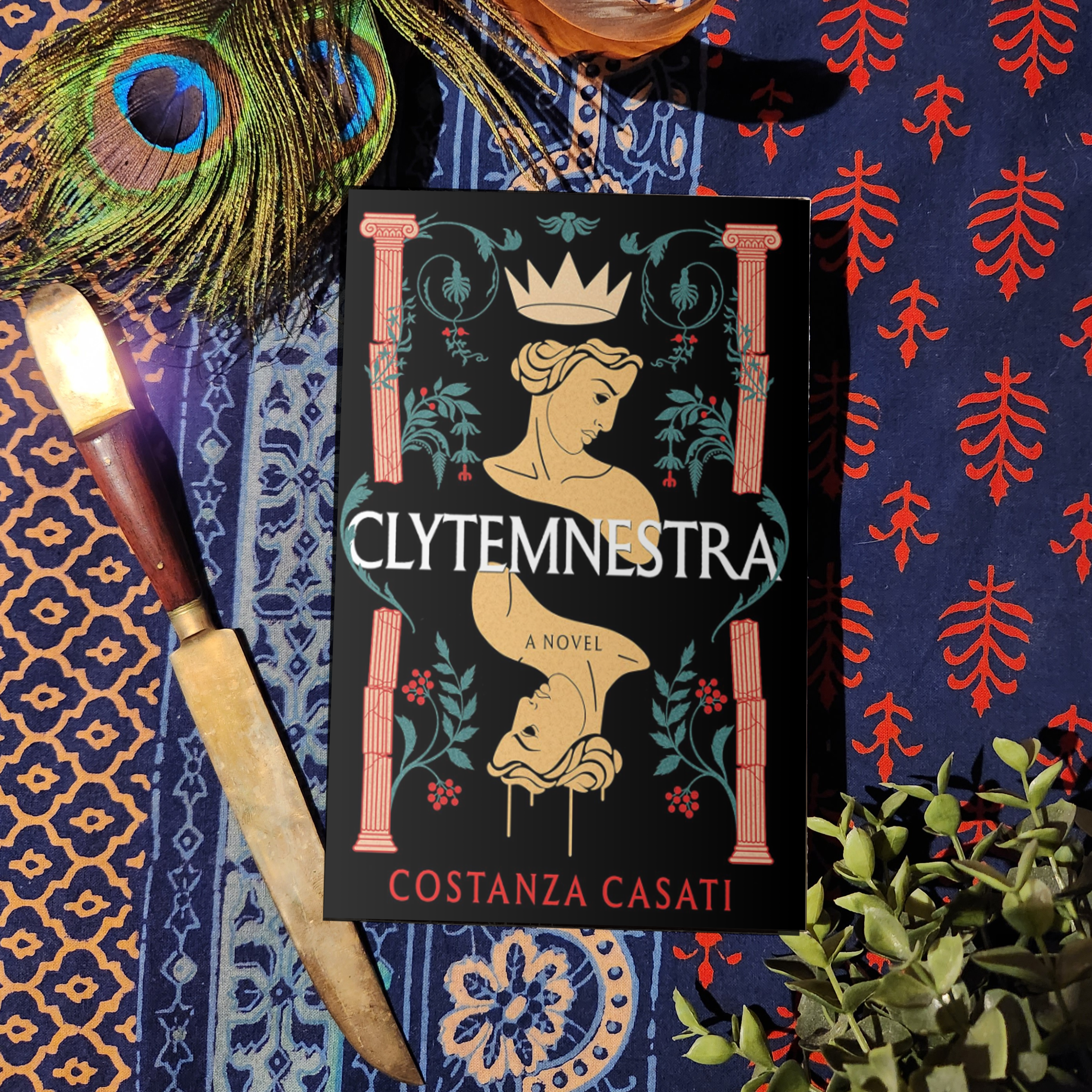
Rating: ⭐⭐⭐⭐⭐
Having recently been on a Greco-Roman mythology kick, I didn’t procrastinate long before getting myself on the library waitlist for Clytemnestra. I’ve read several modern interpretations of Greek myths in the past year, so I could hardly wait to dive into another retelling. This book, a new novel from Texas-born classical scholar Costanza Casati, did not disappoint.
Clytemnestra by Costanza Casati is a retelling of the legend of the titular Mycenean queen, the wife and murderer of King Agamemnon following the Trojan war. The story follows Clytemnestra from her youth as a clever and formidable princess of Sparta, through her transition to family life, and into a world of betrayal and revenge which she must navigate. If you think you know how her story ends, think again.
Clytemnestra is set up from the get-go as a strong and imposing character. As the eldest daughter of a Spartan king, she is raised to be tough and cunning. But it’s her own natural fierceness that makes her stand out as a captial-Q Queen. Her very first scene has her tracking and conquering a lynx, seemingly because she enjoys it, or at the very least wants to impress her parents.
I would pledge myself in a heartbeat to die in battle for Clytemnestra. I applaud Casati’s ability to build a lead character who felt at once legendary and also extremely human. Clytemnestra is all but unmatched in her ability to fight and politically maneuver. She never comes across as too perfect, though—she sometimes fails, treats allies poorly, or is tricked. This fallibility makes her more relatable. She feels like a real queen who lived, not just a distant figure from myth.
But as stunning as Clytemnestra is as a main character, what really shines in this work is how Casati highlights the relationships between the many female characters. They are rich and complex, evolving as the plot progresses—the sisterly connections in particular. Love, trust, resentment, jealousy, loyalty, animosity—the full spectrum of feelings women can have for one another other throughout their lives is on display here. This is mostly because of Casati’s deftness at differentiating this cast of characters. There are so many of them, yet each (the men, too) stands out as their own individual.
My only slight gripe with Clytemnestra is that I felt the point of the book was a little too spelled-out at the very end. It didn’t ruin the book for me, but it did stick out as unnecessary—like maybe Casati wasn’t quite sure how to punctuate the narrative.
Overall, though, this is a beautifully crafted book, and I love this modernized interpretation of Clytemnestra. Casati has blessed her with a sense of justice as well as a dark side. Although I knew the ending, I was on the edge of my seat waiting to see what the Queen would do next. This is the sort of main character I’m here for.
I can’t conceive of giving Clytemnestra anything less than a five-star rating. I was absolutely riveted by it—by her—to the point of making excuses to ditch out on social activities so I could finish this book. She has been a larger-than-life figure for centuries, and while I have seen her character in other literature, I know that this is the version that will live on in my mind as the “real” Clytemnestra.
Shoutout to Olivia Vinall who narrated the audiobook version of Clytemnestra. What a superb reading.
If you agree that Clytemnestra by Costanza Casati was a stunner and want more of this sort of thing, consider these fine books:
–Lore Olympus by Rachel Smythe
This gorgeous web comic is a modern retelling of the story of Persephone and Hades. As of now (September 2023) it is ongoing. Read it for free on Web Toon, or get your hands on the graphic novel adaptation.
–A Thousand Ships by Natalie Haynes
From award-winning author, comedian and journalist Natalie Haynes, this is the story of Troy told by the women who were there (except for HELEN because REASONS). Put your library card to good use for this one—check it out or place a hold on the Libby app.
–Mythos by Stephen Fry
Legendary comedian and storyteller Stephen Fry lovingly penned this engaging and humorous crash course on the Greco-Roman pantheon. It’s also available through Libby.
How would you rate Clytemnestra? What are your recommendations for modern adaptations of ancient myths? Holler at me in the comments or on Bookstagram!
 Adequate Squatch Presents