• About Me
  • Reviews

Adequate Squatch Presents

~ a book review blog

Adequate Squatch Presents

Tag Archives: Pushing 30 Reading Challenge

Ready Player One by Ernest Cline

16 Saturday May 2015

Posted by Mallory F in Reviews

≈ Leave a comment

Tags

80s, books, fantasy, Pushing 30 Reading Challenge, Reviews, sci-fi, video games

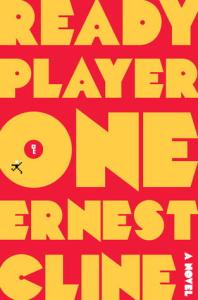
Ready_Player_One_coverIt’s this kind of book that makes me feel like a shitty reader. I appreciate good writing. I absolutely do. I recognize a master when I see him or her. I’ve read some really good authors in the past few months, even if I didn’t necessarily agree with their plot choices. The book I’m reviewing today, Ready Player One by Ernest Cline, was not the best-written novel I’ve read by a long shot. I recognize that. But dammit if it wasn’t fun as hell.

Set in a dystopian future, Ready Player One opens in an America that has been devasated by overpopulation and an unyielding energy crisis. The only thing keeping the unwashed masses in check is a thriving virtual world called the OASIS. Here, anyone can do anything. A nobody can become somebody. A person’s wildest dreams can be realized. The possibilities in this virtual utopia are nearly limitless and many choose to live as much of their lives inside it as possible. When its creator dies suddenly and wills his fortune to whomever can find his “Easter egg” hidden in the OASIS, both the physical and virtual worlds are in an uproar. And so the race begins. Young Wade Watts, a nobody living in an Oklahoma trailer park, throws himself whole-heartedly into the search for the egg. But when he uncovers the first clue and becomes an instant celebrity, no one is as surprised as he is. Thrust into the limelight, Wade finds that the stakes in this contest are far higher than he ever imagined.

Since I began this challenge, I’ve read most of the books at a plodding pace. A couple chapters during my lunch break. A few pages before I fell asleep in the evening. But I went through this one in less than a week. The world (both real and virtual) that Cline created kept me captivated from start to finish. The descriptions of the different “planets” within the OASIS, the workings of the virtual world and the interactions of the social classes within it were very interesting to me. I also found Wade’s struggles to balance his real life with his time in the OASIS to be fascinating and somewhat heartbreaking. As a whole, the plot drew me along, keeping me in anticipation of what would happen next. It was a perfect model of rising action, climax and falling action that kept me excited and left me satisfied when it was all over. No innuendo intended.

But it wasn’t all good. The main character arc was very predictable. So were the interactions between the characters — I won’t spoil it for you by saying that, yes, of course Wade gets the girl of his dreams at the end. You can see that coming from a mile away. The protagonist, a head of an Evil Corporation, is just as much of a mindless sociopath as you would expect, with no sympathetic qualities to redeem him. There was one supporting character for whom there was a twist that I didn’t see coming (while I did guess that there would be some kind of big reveal with this character, I was wrong about what that was). But for the most part, the character development aspect of this novel was rather weak in my opinion.

The other weakness of this novel was in the mountains of information on 80s pop culture. It figures pretty majorly into the plot of the novel, but the way it’s handled ends up being kind of clunky at times. The plot can be moving along quite swimmingly, and then you get three pages talking about an 80s TV show or video game that Wade has identified as important in his quest for the Egg. It’s just kind of wedged in there, and it interrupts the flow of the story. Like, it’s neat that 80s pop culture makes a comback in the future. The juxtaposition of futuristic technology with old arcade games and references to Family Ties is kind of neat, an anachronism not so unlike the steampunk trends from a few years ago. But the way the references were handled and the way that that information was communicated to the reader seemed rather hamfisted. I think it could have been integrated into the story rather more smoothly.

But these complaints were fairly minor with regards to my enjoyment of the book. It was no great piece of literature, but it was a fun and easy read. I could definitely see myself re-reading it in a few years.

And yet, with all its fun and fantasy and sci-fi appeal, this book strikes an ominous chord. It’s easy to draw parallels between what happened to the America in which Wade Watts lives and where our own country could be headed. An energy shortage colliding with a demand fed by an ever-growing population isn’t so far-fetched. And with advances in gaming technology, particularly virtual reality devices such as Oculus Rift, it’s easy to imagine people withdrawing more and more from the real world in favor of the virtual. The jump from having conference calls or hanging out with friends over Skype to experiencing them through avatars inside a virtual environment — that’s really not that big at all. And I’m sure it’s something we’ll see in the coming years. It’s exciting, but what might the consequences be if we begin neglecting the old world to live more in the new?

But there is hope! There is aspect of Wade’s reality that will never come to fruition in our own. I have reasonable confidence that, should the citizens of our nation (and even the world) begin flocking in large numbers to one of our cities, and should that city become the world’s new metropolitan hub of technology and innovation, that city will not in fact be Columbus, Ohio.
A Heartbreaking Work of Staggering Genius by Dave Eggers

24 Tuesday Feb 2015

Posted by Mallory F in Reviews

≈ Leave a comment

Tags

literature, nonfiction, Pushing 30 Reading Challenge, Reviews

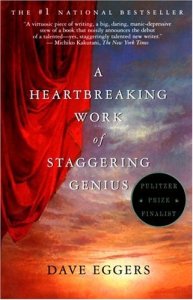
tumblr_l7tef8fihn1qaouh8o1_400As I’m sure it was designed to do, the title of this book caught my eye. It stood out among the myriad titles on the reading list, written in pink ink on notebook paper, that I have tacked up in my cubicle. A heartbreaking work, it claimed to be, not just of regular, run-of-the-mill genius, but of staggering genius. I had no idea what it was about, just that the title made it out to be something amazing. But “heartbreaking” and “staggering genius” can describe a lot of genres. Was it a transcendent romance for the ages? Was it a tale of atrocious abuse and neglect overcome by unwavering optimism? Did it follow the lives and trials of the sentient roundworms inhabiting a planet in the Mintaka solar system? Whatever it was, I was ready to be forever changed by reading it.
Turns out that it’s a memoir. Sort of. It covers actual events that happened in Eggers’ life — the loss of his parents to cancer, becoming the guardian to his younger brother, their move to San Francisco — but it’s clear that the author has exaggerated or fictionalized certain parts of the story. Dave chronicles his (often feeble) struggles to have an impact on the world, balancing his ambition with his new parental responsibilities. It is a blend of humor, philosophy and self-reference that makes for a compelling read.

Having finished it, I can definitively say that I don’t know what to make of this book. On the one hand, it was beautifully written. Eggers shows a prodigious command of the English language, and his writing is a true pleasure to read. The narrator speaks intimately to the reader, as if confiding in a friend — a mix of gritty truths, ridiculous exaggerations and deep personal insights. By the end, I felt like he was someone I knew.

On the other hand, the fact/fiction blend blurred the storyline and sometimes made it difficult to follow. Eggers often exaggerates events or dialogue or makes them up. Which is cool. The book does not claim to be completely true, and sometimes alludes to the fact that certain parts are indeed made up. This creates an interesting reader-narrator relationship. The reader recognizes that the narrator is unreliable, but the narrator admits that he is unreliable, so that, I guess, makes him reliable in his unreliability? If that sentence is confusing, then you’ve gotten a taste of how I felt the whole time I was reading.

Eggers often takes breaks from exposition in order to wax poetic on subjects such as his (or his character’s) personal insecurities and where to draw the line between personal and public life. It’s all very honest and self-referential, but can seem a bit masturbatory at times. The book is very self-aware, admitting its self-awareness, and then admitting the admission of its self-awareness. It got (for me) tiresome after a while. I get it, dude. You’re so meta it’s killing me.

So while I enjoyed reading A Heartbreaking Work of Staggering Genius, it was not the life-changing experience I expected from the title. Was it heartbreaking? Not particularly. The characters were appropriately tragic and identifiable, but never vulnerable enough to elicit an emotional response anywhere close to “heartbreaking”. Is Dave Eggers a genius? It’s very possible. His writing is very good. That writing an entire book which basically screams “recognize me for my genius!” won him a bunch of awards is pretty genius in and of itself. But I’m not entirely sure I buy it.

White Teeth by Zadie Smith

14 Wednesday Jan 2015

Posted by Mallory F in Reviews

≈ Leave a comment

Tags

books, literature, Pushing 30 Reading Challenge, race, religion, Reviews

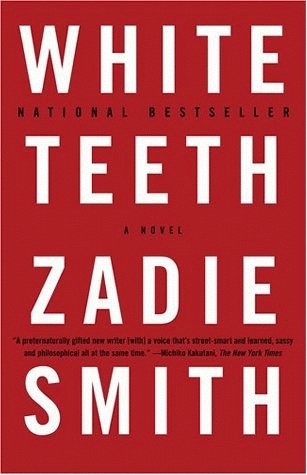
3711Zadie Smith, I should start out by saying, is a good author. A really good author. I was skeptical reading the first couple chapters of this book, which follows characters so unlikely, so far from the archetypal “everyman,” that I didn’t think I could find their stories interesting at all — people so dramatically removed from my demographic that I wasn’t sure there was anything I could gain from reading about them. I was proven wrong; I did become quite interested, enough so that I came back late from several lunch breaks, frustrated that I didn’t have time to stay and see the characters through to the end.

White Teeth is about a lot of people living in late 20th-century England. First it’s about Archie Jones, a painfully average man and World War 2 veteran, whose suicide attempt is averted by what he sees as forces of fate. It’s about his young wife Clara, a former Jehovah’s Witness from Jamaica with a desire to leave her roots behind. It is about his best friend and army comrade Samad Iqbal, a pious Muslim and former intellectual, disappointed in his own inability to leave a mark on the world. It’s also about the children of these people, Samad’s twins Magid and Millat, and Archie and Clara’s daughter Irie. The second half of the book in particular deals with the dreams and struggles of these young people. The book is about identity — what does it mean to be Jamaican? Bengali? Mixed-race? Muslim? English? Or any combination of these things? Which of these identities should be first, and why is it shameful to believe otherwise? It’s about duty to one’s family, one’s country, one’s religion. This novel covers a lot of ground and it does a beautiful job, weaving the lives, dreams and tribulations of its characters together with magnificent and engaging prose.

That said, I felt thoroughly blue-balled by this novel. Such a gorgeously-crafted story that spans demographics and generations, I thought, must have an equally beautiful ending. I wanted to get there, to find out the final destination of this captivating journey. However, I felt like I’d made a cross-country trip to Disneyland, only to be met by a “closed for renovations” sign. Or maybe it’s more like establishing a long and fulfilling pen-and-paper relationship with a penpal and right before you’re about to meet for the first time, you get a letter from his mother saying that you won’t be hearing from him anymore with no further explanation. Maybe I should stop trying to come up with similes.

I certainly can’t presume to tell anyone how to write. I need tips myself. And Zadie Smith is undoubtedly a million times better at it than I am. I do happen to be a pretty avid reader, though, and as such I’ve developed certain expectations from a novel. Is it horrible if those expectations are shattered now and then? No, in fact sometimes it’s really good. But at the bare minimum I expect a story to have a goal. And I can’t for the life of me figure out what the goal of this novel was. In fact, the last page and a half pretty much says to the reader, “I bet you want to know what happens. Fuck off, this story doesn’t work that way.” There is a climax of sorts, but no resolution.

So I have to wonder, what story were you trying to tell, Zadie? All these characters who I’ve come to care about are brought together, all the energy of their conflicts coming to a head at one pinnacle event, and then the story ends. It seems like a self-indulgent “fuck you” to the reader. And why write a novel if that’s where you want to go with it? I’m really baffled and disappointed.

I know, the destination doesn’t matter as much as the ride. And that seems to be the “moral” of the whole book — that the destination is never the utopia we imagine it to be, and real life doesn’t always have resolution. But I think it does matter, and I think that such a great story at least deserves a decent resolution. Maybe I’m being too entitled as a reader, but a lifetime of escapist reading has given me that expectation. I feel cheated.

Read this if you enjoy great character development and superior prose, but definitely don’t expect any payoff at the end. If the destination doesn’t matter, if the ride itself is good enough for you, then this might be your novel.

What She Saw… by Lucinda Rosenfeld

07 Wednesday Jan 2015

Posted by Mallory F in Reviews

≈ Leave a comment

Tags

depression, literature, Pushing 30 Reading Challenge, relationships, Reviews, sex

105778I was misled by the seemingly ominous ellipsis in the title of this book. It annoyed me that it was there, mainly because I interpreted it as ominous in the first place. I took it as “She has seen some shit,” with the ellipsis meant to emphasize that it was some serious shit. I envisioned a gritty novel about a promising young girl suffering sexual abuse and coping with its consequences as she came of age. Taken that way, I thought it was completely unnecessary. That’s not how one uses an ellipsis. It continued to bug me as the book sat on my kitchen counter waiting to be read. The title would just feel so much better without that punctuation hanging there.

I guess I gave the author too little credit, because the ellipsis made a lot more sense once I actually opened the book. It was about a girl/young woman’s (non-abusive) relationships with men. The title corresponses to the chapter names so that, together, they read “What she saw…in [guy’s name].” Okay, that works. It made me feel a little better. Now I could get on with my reading in relative peace.

What She Saw… follows Phoebe Fine from middle school to her mid-twenties, and mostly deals with her relationships across this time period. An intelligent girl with a gift for language and the violin, it seems like she has a bright future ahead of her. But beneath her privledged upbringing and educated mannerisms lurks naivete and a host of self-image issues that lead her down a destructive path as she looks to a series of questionable male influences to validate her as a person. In a tale of middle-class dreams gone wrong, Phoebe’s story is often funny, sometimes sad and sometimes cringeworthy.

As a character, Phoebe seems to have a lot of issues for someone so average. Her parents are musicians and lovers of classical music, but still manage to send their children to a prestigious prep school. She takes on multiple extracurricular activities, has a penpal and gets her parents to drive her to the roller rink on the weekends. However, it seems that, from an early age, Phoebe measures her worth in terms of her relationships with boys. Her female “best friends” play disposable, minor roles, and she has a new one every chapter or so. Where she feels it’s necessary, she tells lies to make herself seem more attractive to prospective dates. In an attempt to remain thin and “attractive,” she develops bulemia. She seems to continually be drawn to the “wrong” guys, from the class clown to the out-of-her-league lacrosse star to the married sociology professor. And whether she actually loves any of these guys is debatable. She seems to achieve every conquest she sets out to make, and those conquests make her feel good. Yet when she finds that the relationships aren’t all that she wishes, she tries to “punish” these men, often by behaving in self-destructive ways.

So what happened? What wires got crossed, damaging Phoebe to the point of being unable to maintain a healthy relationship with herself or others? Phoebe’s sister, who has a very minor role in the novel, seems to play a big part in Phoebe’s constant need for validation. She’s mentioned only a few times, briefly, but it’s always in the context of Phoebe’s resentment toward her success — her ivy-league degree, her successful career, her fantastic marriage. Phoebe perceives her parents’ disappointment in their younger daughter, even though they never voice it. Never feeling that she can measure up, she seeks approval from the opposite sex, because if she can’t be successful then at least she can be lusted after.

But does she grow over the course of the novel? It’s not really clear. At the end, it almost seems like she’s achieved a sort of experienced wisdom about relationships. But since it ends on a new beginning, the reader can’t really be sure if this is the start of something better and more fulfilling for Phoebe, or if it’s the entrance to a road that leads to more of the same. It leaves the reader hopeful, I suppose, but it doesn’t feel like any resolution has been reached.

Prose-wise, I thought that What She Saw… was done very well. Rosenfeld’s language was natural and captivating, and that’s mainly what kept me reading this book. Phoebe’s character was pretty unnerving at times, but the story was written well enough that I decided to stick around to see what she did next. Was it worth it? I don’t really know. This is one of those books that I don’t feel I can form a strong opinion about. My feelings on this novel extend to, “Yep, I sure did read it.”

Was it a valuable read for someone in their twenties? I suppose it shows that people’s mistakes don’t have to define them. People can change. People can grow up. For some of us, it takes a little longer. It also shows the dangers of placing too much emphasis on what others think — when you base your sense of self-worth on the opinions of others, you’re going to have a bad time. Maybe I wasn’t too thrilled with this read because these are things I feel I’ve already learned.

And for what it’s worth, I would have chosen a title without an ellipsis.

Pushing 30 Reading Challenge (Part II): The Emperor’s Children

18 Thursday Dec 2014

Posted by Mallory F in Reviews

≈ Leave a comment

Tags

9/11, books, literature, Pushing 30 Reading Challenge, Reviews

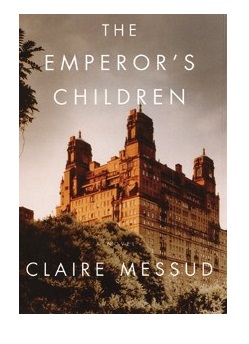
The_Emperor's_Children_book_coverComing off of reading His Dark Materials, I was a little angry when I started reading this book. I didn’t want to read about REAL people, I wanted to stay in my fantasy world of moral black and white. I found it so jarring to switch from a story with characters so lovable and blameless to a realistic fiction piece about obviously flawed people operating in moral gray areas. So I began reading The Emperor’s Children in the lobby of a Hyundai dealership (I happened to be getting an oil change that day) with a really pessimistic attitude.

This novel is mainly about three friends in their early thirties (and one chunky, awkward college-age boy) and their attempts to do something meaningful with their lives, mostly in terms of romance or career. They all live in New York. They all think all of the others have “issues”. None of these characters is particularly likable. Marina, who promises she’ll one day finish her book about how children’s clothes reflect social issues, is the daughter of a celebrated journalist. Danielle is a documentary film producer who seems to be sensible about everything except love. Julius is a freelance reviewer who is desperately trying to throw off his rural Michigan roots and live a more extravagant lifestyle than his writing can really pay for. Marina’s unfortunately-named younger cousin, Frederick “Bootie” Tubb, fancies himself an intellectual beyond his years and moves to New York hoping to find a like-minded mentor in his successful uncle. These four find that their best-laid plans don’t tend to work out quite like they’d hoped. This novel is also loosely about 9/11, which blindsides everyone near the end of the book (spoiler? Though in a book about early-00s NYC, what else is it going to be about?), making all their struggles and wishes seem petty and irrelevant. Yeah, this book seemed like it was going to be a bit of a downer.

During the first chapter, which follows Danielle as she muddles through a dinner party while inwardly scoffing at all the other attendees, I decided that I wasn’t in the mood for this kind of book. The judgmental attitude, cynical inner voice and forced interest that Danielle presented at the beginning of the book — well, it perhaps hit a little too close to home for my liking. But realizing that was probably the reason I kept on reading.

It didn’t help my optimism when I discovered that the sentence structure was often extremely convoluted. All the commas and nested statements, sometimes going for half a page before encountering a single period, was really unnerving at first. You give me characters with false facades and scathing inner monologue thinly concealing their own self-loathing AND ridiculously longwinded run-on sentences on top of that? If I hadn’t been stuck at the dealership for an hour and a half, I would have given up in the first chapter. But I was surprised at how quickly I got used to the writing style. I by the third chapter in, I didn’t even blink at a half-page sentence.

Despite my initial cynicism, though, The Emperor’s Children managed to change my mind. I began to feel for the characters and their struggles, even if I didn’t agree with their decisions (and there were a lot of parts during which I shouted at the page something akin to “WHY WOULD YOU DO THAT?” — in my head, of course, I don’t typically emote to the level of screaming at inanimate objects). It’s a credit to the author that she could make me sympathize with each and every character in the book, even Marina, who I found particularly irritating. I saw a bit of myself in Bootie whose ridiculous self-righteousness was only apparent to himself in retrospect, and in Julius who couldn’t seem to reconcile his desire for a committed relationship with his distaste for stagnancy. There’s this expectation that a person should have their life figured out by thirty, and admitting that you don’t — that you’re faking it just as much as you were in high school — is tough to do. I could sympathize with that, even if I didn’t exactly agree with the characters’ ways of dealing with that difficulty. By the end they all seem to reach, if not a resolution, then an uneasy peace with their respective situations. In the face of a terrorist attack, certain pills just seem easier to swallow. Pretty much everyone’s arc ends with a spark of hope in the face of personal tragedy.

Will I ever re-read this book? Probably not. It was a little too depressing, and I’m a sucker for a happy ending. I think it’s an insightful look into quarter-life crisis — which appears to be becoming more of a thing for millenials who are spending more years living at home and maybe not having such a good time coping with that. The Emperor’s Children shows that maybe some of us adults are not as well-adjusted as people think we are (or as we’d like others to think we are). That can be a tough truth to come to terms with, which is maybe why this wasn’t the most fun read for me. But it also shows that it’s never too late to turn things around.

Pushing 30 Reading Challenge — His Dark Materials

15 Monday Dec 2014

Posted by Mallory F in Re-Reads

≈ 1 Comment

Tags

books, fantasy, Pushing 30 Reading Challenge, Reviews

I really dislike Buzzfeed, so I want to make it clear that this post (or series of posts, we’ll see how far I get) is in no way condoning Buzzfeed or their clickbait articles. But a friend referred me to an article of theirs (not an article, actually, a list is more accurate) boasting “65 Books You Need to Read in Your 20s.”  (Not including a link, because suck it BF.)

Well, I’M in my 20s, I thought. Let’s see how well I’ve done on this OH SO ESSENTIAL list of literature. Turns out, not very. I’ve read maybe three books on the list, and most of them I’ve never even heard of. I consider myself pretty well-read, so this made me a little angry. Why did I need to read these books? What was so special about them? I’ll show you, Buzzfeed, I thought. I’ll read all those goddamn books, you just watch, and they’ll probably be stupid anyway.

Yeah, I’m really not sure what I’m trying to prove with this one, but I’ve been cruising through books lately and continually looking for suggestions on what to read.  With a year and a half left in my 20s, it seems like an interesting challenge to take on, at least to see how far I can get.

It just so happened that at the time I perused this list, I was actually re-reading one of the books (a trilogy, actually) that was on it. So if I’m going to document my journey, that seems like a good place to start.

910mw93VxwL._SL1500_

I read Philip Pullman’s His Dark Materials trilogy for the first time when I was about 14/15. It pulled me in from the first chapter and kept me captivated all the way through to the last sentence. It made me feel emotions I’d never felt before, bringing me the greatest happiness I’d ever gotten from literature while simultaneously breaking my heart into little pieces that I struggled to make sense of in the days and weeks after I finished it. It’s been a favorite of mine since, and I’ve had to rebuy all three books multiple times when they’ve been lost to roommates, friends or relatives with whom I wanted to share the complex joy the story brought into my life.

The narrative of the first novel, The Golden Compass (originally titled Northern Lights when it was published in the UK), follows Lyra, an orphan from a universe much like our own yet notably different in several ways. When her best friend is abducted by a group rumored to be doing terrible experiments on children, she goes to great lengths to rescue him. She befriends gypsy sailors, witches and armored polar bears in a quest that takes her into the secretive, bitter cold of the icy North. On her journey she ends up involved in plans and politics far beyond her comprehension, yet in which she is destined to play an important role. She leaves her own universe in search of answers and (Book #2, The Subtle Knife) ends up meeting Will, a boy who hails from our own world and finds himself in trouble as he searches for clues to the whereabouts of his missing father. The children agree to help each other and find that their objectives have more in common than they ever would have guessed. When Will inadvertently becomes the bearer of a knife that can cut portals into other universes, they gradually come to realize that their actions may have great consequences across many worlds. Book #3 (The Amber Spyglass)…well, a lot happens and I really have no idea how to summarize it without giving spoilers, but it involves journeying to the world of the dead, a mysterious substance colloquially referred to as Dust which has some unknown connection to human consciousness, and a war against (or to liberate) Heaven itself.

I thought, perhaps, that reading it as an older adult (I did read it another time at about 20/21) might not have the same effect it had when I was young. Perhaps my raging hormones and anger at the world caused these novels to affect me much more then than they would now. I was wrong. It was just as heartbreaking this time around, leaving me, as I turned the last page, feeling like I was saying goodbye to my greatest friends.

This is not to say that the books are without flaws. Particularly in the third book, some characters just seem too pure to believable, and their adversaries seem too willing to be bowed by that purity. Plans seem to go too perfectly and dialogue seems, at certain points, too forced or elegant to be genuine. But at no point did these flaws take me out of the story, and they didn’t bother me enough to sully my love for the trilogy as a whole. I really can’t say enough how much I love this story.

Perhaps it seems that I’m ignoring the elephant in the room. The name of said elephant is Religion. These books received quite a bit of criticism for allegedly promoting an atheist, or even anti-theist, agenda. The outrage over this went so far as to have religious groups picketing screenings of the film adaptation of The Golden Compass. It’s true that Philip Pullman is an outspoken atheist and his trilogy contains strong atheist undertones — after all, one of the supporting characters literally sets out to kill God. The church and its priests are constantly working against the protagonists, and their aims and beliefs are portrayed as misguided at best, malicious at worst. Where the main characters are almost too pure, the agents of the Magisterium (thinly-veiled portrayal of the Catholic church) are almost too one-dimensionally evil. Is it still a great story? Absolutely yes. I would say that this is not a book to have your kids read if you’re raising them to be religious, but I think it’s a worthy flip-side to the coin of beloved Christianity-heavy fiction like The Chronicles of Narnia — which I also really enjoyed as a kid. (As a side note, yes I am an atheist, and no that’s not because an impressionable, young version of me read these books — that decision didn’t happen until college and was the result of a lot of study and careful consideration.) More than anything, I think that His Dark Materials encourages the reader to live a good and enriching life, rather than slogging along in anticipation of what might come after.

These books span a lot of time, space and action. They’re about a lot of things, and different aspects of the story evoke different emotions from different people. Some people will say that it’s about vanquishing religion or about finding love in an unlikely place or overcoming your flaws to do what’s right. None of those answers are wrong. I think that for me, at its core, this trilogy is about following your instincts. It’s about friendship, trust, the purest love and the consequences of those absolutely essential things. It’s about living your life with kindness and curiosity, giving it meaning through your own actions. Those are the lessons that I carry with me from my readings of these novels. Honestly, I can’t wait to read them again.

So, if I feel like it I may continue documenting my journey through this list. So check for updates if you’re at all interested. I can make no promises as to the regularity of those updates, or if they’ll happen at all. All I can say is that something might happen, and it might be interesting!

Pages

  • About Me
  • Reviews
  • Instagram
  • Threads
  • Goodreads

      9/11 80s afterlife amazon anne rice asian lit A Song of Ice and Fire book-review book-reviews books classics comedy depression experimental fiction fantasy fiction florida free Game of Thrones gothic grady hendrix graphic design historical fiction horror humor isabel-canas king arthur literature manga memoir motherhood murder mystery mythology nonfiction novellas nuclear Palahniuk public domain Pushing 30 Reading Challenge race relationships religion Reviews rl stine romance sci-fi sex shapeshifting slasher southern gothic stephen graham jones stephen king suspense thriller true crime twilight vampires video games wicked witches YA horror

      Blog at WordPress.com.

      • Subscribe Subscribed
        • Adequate Squatch Presents
        • Already have a WordPress.com account? Log in now.
        • Adequate Squatch Presents
        • Subscribe Subscribed
        • Sign up
        • Log in
        • Report this content
        • View site in Reader
        • Manage subscriptions
        • Collapse this bar
       

      Loading Comments...