
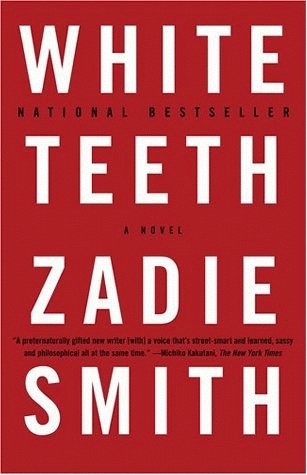
 Zadie Smith, I should start out by saying, is a good author. A really good author. I was skeptical reading the first couple chapters of this book, which follows characters so unlikely, so far from the archetypal “everyman,” that I didn’t think I could find their stories interesting at all — people so dramatically removed from my demographic that I wasn’t sure there was anything I could gain from reading about them. I was proven wrong; I did become quite interested, enough so that I came back late from several lunch breaks, frustrated that I didn’t have time to stay and see the characters through to the end.
White Teeth is about a lot of people living in late 20th-century England. First it’s about Archie Jones, a painfully average man and World War 2 veteran, whose suicide attempt is averted by what he sees as forces of fate. It’s about his young wife Clara, a former Jehovah’s Witness from Jamaica with a desire to leave her roots behind. It is about his best friend and army comrade Samad Iqbal, a pious Muslim and former intellectual, disappointed in his own inability to leave a mark on the world. It’s also about the children of these people, Samad’s twins Magid and Millat, and Archie and Clara’s daughter Irie. The second half of the book in particular deals with the dreams and struggles of these young people. The book is about identity — what does it mean to be Jamaican? Bengali? Mixed-race? Muslim? English? Or any combination of these things? Which of these identities should be first, and why is it shameful to believe otherwise? It’s about duty to one’s family, one’s country, one’s religion. This novel covers a lot of ground and it does a beautiful job, weaving the lives, dreams and tribulations of its characters together with magnificent and engaging prose.
That said, I felt thoroughly blue-balled by this novel. Such a gorgeously-crafted story that spans demographics and generations, I thought, must have an equally beautiful ending. I wanted to get there, to find out the final destination of this captivating journey. However, I felt like I’d made a cross-country trip to Disneyland, only to be met by a “closed for renovations” sign. Or maybe it’s more like establishing a long and fulfilling pen-and-paper relationship with a penpal and right before you’re about to meet for the first time, you get a letter from his mother saying that you won’t be hearing from him anymore with no further explanation. Maybe I should stop trying to come up with similes.
I certainly can’t presume to tell anyone how to write. I need tips myself. And Zadie Smith is undoubtedly a million times better at it than I am. I do happen to be a pretty avid reader, though, and as such I’ve developed certain expectations from a novel. Is it horrible if those expectations are shattered now and then? No, in fact sometimes it’s really good. But at the bare minimum I expect a story to have a goal. And I can’t for the life of me figure out what the goal of this novel was. In fact, the last page and a half pretty much says to the reader, “I bet you want to know what happens. Fuck off, this story doesn’t work that way.” There is a climax of sorts, but no resolution.
So I have to wonder, what story were you trying to tell, Zadie? All these characters who I’ve come to care about are brought together, all the energy of their conflicts coming to a head at one pinnacle event, and then the story ends. It seems like a self-indulgent “fuck you” to the reader. And why write a novel if that’s where you want to go with it? I’m really baffled and disappointed.
I know, the destination doesn’t matter as much as the ride. And that seems to be the “moral” of the whole book — that the destination is never the utopia we imagine it to be, and real life doesn’t always have resolution. But I think it does matter, and I think that such a great story at least deserves a decent resolution. Maybe I’m being too entitled as a reader, but a lifetime of escapist reading has given me that expectation. I feel cheated.
Read this if you enjoy great character development and superior prose, but definitely don’t expect any payoff at the end. If the destination doesn’t matter, if the ride itself is good enough for you, then this might be your novel.
 Adequate Squatch Presents